I
am in the Coronary Care Unit in the Whittington hospital. I had slept pretty badly as the man next to
me called out for the nurse on the hour, every hour it seems, to ask for
something to help him sleep. She
conversed with him loudly, mostly jolly banter but that is not what the rest of
the patients want to hear in the middle of the night. She then starts noisily tidying away heart
monitors at 0600hrs. Perhaps most of her
patients are so ill that they will sleep through anything, but I don't.
The process last night in A&E had been surprisingly efficient. I was seen within 10 minutes, history taken, within an hour was sent for X-ray (what for I am not sure), had bloods taken, and an ECG. I had a raised level of troponin, which is a protein produced by the heart muscle when it has been damaged, and the ECG showed some abnormalities. I was diagnosed with unstable angina. In other words, I had suffered a minor heart attack and I could again either at rest or as a result of exercise. I had been admitted to the Cardiology ward and was on strict bed rest and a heart monitor.
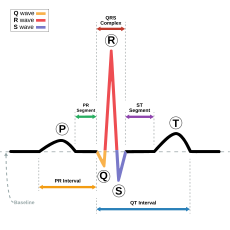
Sinus Rythmn labels.
The process last night in A&E had been surprisingly efficient. I was seen within 10 minutes, history taken, within an hour was sent for X-ray (what for I am not sure), had bloods taken, and an ECG. I had a raised level of troponin, which is a protein produced by the heart muscle when it has been damaged, and the ECG showed some abnormalities. I was diagnosed with unstable angina. In other words, I had suffered a minor heart attack and I could again either at rest or as a result of exercise. I had been admitted to the Cardiology ward and was on strict bed rest and a heart monitor.
Sinus Rythmn labels.
A series of junior doctors float by, asking a couple of questions and moving on. Eventually, late afternoon, the Consultant, on her ward round, approaches. She is business like but easy to talk to and sympathetic. She tells me I have had a heart attack and that I must rest. I will be sent to Bart’s hospital for an angiogram.
The
possible outcomes are explained:
1.do nothing (treat with drugs only);
2. Insert a stent or stents to open up narrowed or blocked arteries
3. Refer for bypass surgery.
1.do nothing (treat with drugs only);
2. Insert a stent or stents to open up narrowed or blocked arteries
3. Refer for bypass surgery.
The first option is used where the damage is minimal or they cannot find
anything visibly wrong. The downside is
that it takes a while to stabilise the regime so you are not allowed to drive
for a month. If problems are addressed
with stents (little coils of wire inserted in an artery to hold the walls open
after it has been stretched open with a balloon) then recovery is actually
quicker; no driving for a week. Clearly
recovery time from open heart surgery is a lot longer.
I
ask how long it would be before the tests and she said I will be booked in for
Thursday (tomorrow). The procedure takes
place at Bart’s because the Whittington, although it has an angiogram
facility, does not o stents and this is the most likely outcome. As I have private medical insurance and
wonder if there might be a private room as the ward was not conducive to
sleeping well. The Consultant prefers me
to be in the CCU where I would be more visible.
I was actually thinking of whether I should move to a private hospital
but if the angiogram is tomorrow, there is little point.
I am moved from one section of the ward to another, which is right I front of the nurses' station. This is so I can be attached on a static monitor, replacing the remote telemetry machine I have dangling round my neck. Apparently the consultant think I might try to wander off around the hospital.

No comments:
Post a Comment