Welcome to my Heart Blog.

One Persons's journey to a Coronary Artery Bypass Graft (CABG) and hopefully beyond.

I Began this diary while I was sitting in hospital recovering from a quadruple coronary artery bypass graft (CABG). The aim was to track my progress and think a bit more about the National Health Service acute services, what we should appreciate about it and where we might do better.

I stopped writing when there was, frankly, not much else to record. However in June I signed up for a half marathon and thought I would re-open the blog as a training diary. It may even include a few health and exercise tips along the way.

I am neither a health-care professional nor a sports and fitness guru. What I write is no more expert than some of the things you might here from that bloke in the pub, so I take no responsibility for how you might use my ramblings. Be warned!

If you want to you can read the "back story", from hospital to rehab in earlier blog posts. One thing I have learned is that most people are not interested in reading my ramblings so, for those who do, I promise in future to keep them short.

Tuesday, 30 June 2015

Monday 22nd June. Still no angiogram.


A week today since I first went to the GP.  6 days ago I went to A&E.  Still no angiogram.  And no early start today as it seems that the nurses at Bart’s who said that I would return on Monday morning did not know what they were talking about.  We were never on the list for Monday.   When on Sunday I mentioned to the nurses that I was due to go back on Monday they told me I must be wrong because no one had asked them to arrange it.  They show no signs of being proactive in this so I ask that someone to ring up and check but of course no one is there to talk to them because there are no staff, or patients, at the weekend. 
I decide to call Barts at 0800 hrs and after 15 minutes, being cut-off once and transferred incorrectly twice, I am told that the list for today is full and I am not on it.  Unfortunately the anxiety brings on a bout of chest pain, the first at rest since last Sunday.  Still, a chance for the nurses to do the ECG they have been crying out for.   I tell the consultant (another one) on his ward round about my call and he is upset with me for stressing out!  But later I am cheered when I hear him on the phone to the person who organises the Bart’s lists, using some very direct words to express his displeasure and tell them to ensure we are seen tomorrow. I hope his heart did not suffer!
At least the WiFi is back up again so I can read the paper. I made some progress with Margaret Cameron’s fine book on the origins of the First World War (“The war that ended peace”) over the weekend, though it is quite hard going and I only manage 10-12 pages before having to take a break.   


Friday 19th June. A trip to Bart's.

I am woken up at the uncivilised time of 0530 hrs for the usual breakfast of two Weetabix with cold milk and a cup of tea.  I pack up by belongings and have a shower in readiness for the transfer to Bart’s.  Hospital transport arrives at 0700 hrs.
  
More formally known as The Royal Hospital of St Bartholomew, Bart’s it is part of the Bart's Health NHS Trust, the largest NHS trust in the country, covering most of East London.  The hospital in located at Smithfield in London.  It was founded in 1123 although the first physician was only appointed in 1567 (he was subsequently hung drawn and quartered after being falsely accused of plotting to poison Queen Elizabeth I).  The present buildings were completed in 1770 but fortunately they have been refurbished several times since then.  The entrance takes you into a courtyard and through the original building.   

Then a surprise!  I am in a light, airy, modern atrium. There are no wheel chairs or porters so I walk across the lifts and we go up to the state of the art Heart Unit on the 4th floor.  Perhaps this is where all the money has gone; the Trust has been in the press lately for poor financial management and a deficit approaching £80mln.  I hope that does not mean they will cut corners!

We wait all day for the angiograms but around 1600 hrs a nurse arrives to tell us that they have been cancelled.  Apparently the Cat Labs (as they are called) have been fully occupied with emergencies.  I am naturally disappointed because apparently the labs do not work at the weekend an now I have to spend the weekend waiting in hospital.  The nurse explains that as the procedures have been postponed we will be treated as priority patients on Monday and seen first.  

I am given the option to stay in Bart’s over the weekend but there is no WiFi or phone signal here so I am completely cut off.  This is possibly because the unit has only been open since April, in fact they are still building because I can hear drills not too far away.   Also the ward is cold and the staff cannot adjust the temperature.   In view of this I decide to go back to the Whittington where visiting is also more convenient. 

Thursday 18th June. The angiogram does not happen.

Slept better on the CCU observation  section.  The patients are too ill to cause a fuss.  But the alarms, ringing in the nurses station, including the routine call button, are extremely loud.  Could they not be quieter for the patients' sake?  They seems to be designed to call staff from half a mile away, but surely In an intensive care unit at least one person on the ward should be stationed at the main desk, which has a slave monitor duplicating the data tracked at each bedside.

Well I am not going to Bart's today.  I am not on the list.  How disappointing, especially after what I as told the previous day.  But I am assured that I am on the list for tomorrow. 

The food in here is not bad and the staff are mostly very nice.  I strike up a few conversations with the cleaner, who was once an economist working for a Bulgarian factory making Kalashnikovs. He bemoans the fact that his three children are all settled, with families, in different EU countries and he wishes that they could all be together back home.  But he is also an economic migrant and from a management Job in industry to hospital cleaner is a long way (it is likely that in communist times his title of economist actually meant planner, responsible for preparing plans that met the state's objectives.  If I a right, professional knowledge may be weak on markets and competition). 

The other chatty person is one of the student nurses, also from Eastern Europe.  She is clearly intelligent and studies hard though she wears not very complimentary about the academic part of her training programme, which is essentially self-study.  I think they have 5 hours a week contact time.  Still, she gets lots of on-the-job training because she asks for it and is prepared to ten responsibility.  She will get on.

Wednesday 17th June. The Coronary Care Unit

I am in the Coronary Care Unit in the Whittington hospital.  I had slept pretty badly as the man next to me called out for the nurse on the hour, every hour it seems, to ask for something to help him sleep.  She conversed with him loudly, mostly jolly banter but that is not what the rest of the patients want to hear in the middle of the night.  She then starts noisily tidying away heart monitors at 0600hrs.  Perhaps most of her patients are so ill that they will sleep through anything, but  I don't.

The process last night in A&E had been surprisingly efficient.  I was seen within 10 minutes, history taken, within an hour was sent for X-ray (what for I am not sure), had bloods taken, and an ECG.  I had a raised level of troponin, which is a protein produced by the heart muscle when it has been damaged, and the ECG showed some abnormalities.  I was diagnosed with unstable angina.  In other words, I had suffered a minor heart attack and I could again either at rest or as a result of exercise.  I had been admitted to the Cardiology ward and was on strict  bed rest and a heart monitor.
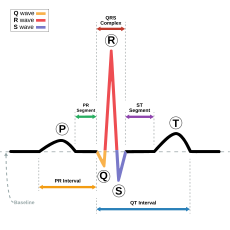
 
SinusRhythmLabels.svg 
Sinus Rythmn labels.   Image from Wikipaedia. Created by
Agateller (Anthony Atkielski)
,  converted to svg by atom.


Ever wondered what those squiggly lines are on heart monitors? 
P wave = depolarisation of the Atria (causing contraction), QRS = depolarisation of the ventricles (causing contraction), S-T segment and T wave = repolarisation.   

When you look into physiology at this kind of level the detail is mind-boggling. The electrical conduction system of the heart is just one small element.Chemical reactions taking place and reversing every second in millions of cells.  So many things to go wrong! 


A series of junior doctors float by, asking a couple of questions and moving on.  Eventually, late afternoon, the Consultant, on her ward round, approaches.  She is business like but easy to talk to and sympathetic.  She tells me I have had a heart attack and that I must rest.  I will be sent to Barts hospital for an angiogram.  

The possible outcomes are explained:
1.do nothing (treat with drugs only);
2. Insert a stent or stents to open up narrowed or blocked arteries
3. Refer for bypass surgery. 
 
The first option is used where the damage is minimal or they cannot find anything visibly wrong.  The downside is that it takes a while to stabilise the regime so you are not allowed to drive for a month.   If problems are addressed with stents (little coils of wire inserted in an artery to hold the walls open after it has been stretched open with a balloon) then recovery is actually quicker; no driving for a week.  Clearly recovery time from open heart surgery is a lot longer.  

I ask how long it would be before the tests and she said I will be booked in for Thursday (tomorrow).  The procedure takes place at Barts because the Whittington, although it has an angiogram facility, does not o stents and this is the most likely outcome.  As I have private medical insurance and wonder if there might be a private room as the ward was not conducive to sleeping well.  The Consultant prefers me to be in the CCU where I would be more visible.  I was actually thinking of whether I should move to a private hospital but if the angiogram is tomorrow, there is little point.

I am moved from one section of the ward to another, which is right I front of the nurses' station.  This is so I can be attached on a static monitor, replacing the remote telemetry machine I have dangling round my neck.  Apparently the consultant think I might try to wander off around the hospital. 

Monday, 29 June 2015

Tuesday 16th June. Visit to A&E


I get up late and have breakfast with Helen.  Too late, I remember the blood tests, which will have to wait until tomorrow.  I go into London for a meeting at 1200 with the President of KCLSU.  On the way to Kentish Town station I decide to walk quickly and see what happens. After 2 minutes of my normal brisk walk the chest pain, dizziness and sweating return.  My lungs feel clear and I can breathe quite deeply but I take two puffs of Salbutamol inhaler anyway.  They make no difference.  After a couple of minutes, I continue at a slow strolling pace.  So long as I go slowly, it seems the problem does not recur.

After the meeting I walk from the Aldwych to Holborn for my regular Tuesday afternoon Russian lesson at the Russian Language Centre in Pushkin House, an independently run Russian cultural centre in London.  This is the last of the term and it passes without incident.  When I got home I decide that while the chest pain might be exercise-induced something, it is not asthma.  Fearing a heart problem, I tell Helen that I want to go to A&E to have it checked out.  She won't let me go on my own, so she drives, but does not wait with me.  We expect the usual hours of hanging around that is normally expected in A&E.

Monday 15th June. A visit to the GP


I call the GP's surgery for an appointment.  Usual problem; you have to call after 0830 am but so does everyone else, so I spend 10 minutes getting engaged signals and pressing the redial button until I get through.  I am offered an appointment with the nurse and I explain that I ought to see the doctor as I need some prescriptions filled.  The receptionist offers me an appointment in two weeks time. I have to explain that I also have chest pains and the receptionist says that the surgery recommends that if I have chest pain I should go to A&E.  Though this conversation is enough to give me one, I am not suffering a pain at the time so she asks me to turn up at 1100 hrs and wait.  While I could go to A&E hanging around for hours does not appeal to me and anyway I had a number of things I wanted to talk to my GP about.

On the way to the GP surgery I walk fast for two minutes and the chest pain comes on quickly.  I have to pull up, stop, take some deep breaths and wait for the dizziness to go.  The pain also subsides, at least enough for me to continue, but only very slowly.  Any attempt to speed up immediately brings it back. 

The GP listens to my story, but does not really hear me out.  I think she is pressed for time. She decides to do some blood tests but her view is that I have exercise-induced asthma.  I have had mild asthma for about 20 years but it has been controlled with daily inhalers (beclametazone) and I very rarely use the salbutamol inhaler; perhaps twice in the last two years during cold weather and never for exercise.  She says I should use the inhaler when exercising if I feel tightness in my chest.  I am a little surprised but accept the advice and take away the blood test form.  The GP does not test bloods an I have to go to the local hospital in the morning, fasting.  Fasting apart, I do think that a lot of time might be saved if these tests were one in the GP surgery, which is what happened when I visited the doctor in Switzerland some time ago. 

I go home and did little for the rest of the day, though Helen was fit enough to go the the London Hash.  I was clearly not.